

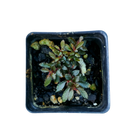
Triolena pileoides
Pickup available at 1420 Costner School Road
Usually ready in 2-4 days
Native to the humid cloud forests of Colombia, Ecuador, and Peru in northwestern South America, Triolena pileoides is a rare member of the Melastomataceae family and one of the more unusual foliage plants available for vivarium culture. Although relatively uncommon in cultivation compared to Begonias and aroids, this species has gained a devoted following among terrarium enthusiasts due to its remarkable leaf texture, compact growth habit, and excellent performance in high-humidity environments.
Members of the Melastomataceae are often recognized by their distinctive leaf venation, and Triolena pileoides is no exception. The foliage typically displays prominent parallel veins that create a deeply textured appearance across the leaf surface. Depending on growing conditions, leaves may exhibit varying shades of green, bronze, olive, or reddish undertones, often becoming more colorful when grown under bright filtered lighting. The combination of texture, venation, and coloration gives the plant a distinctly prehistoric character that stands apart from many commonly cultivated terrarium species.
In habitat, Triolena pileoides grows within moist montane forests where humidity remains consistently high throughout the year. It is frequently associated with shaded understory environments, moss-covered slopes, decomposing organic matter, and areas receiving regular moisture from cloud cover and rainfall. These conditions closely mirror those found in well-established tropical vivariums, making the species exceptionally adaptable to enclosed cultivation.
Unlike aggressively spreading groundcovers, Triolena pileoides typically develops as a compact understory plant that remains manageable within terrarium settings. This restrained growth habit allows it to serve as an excellent focal specimen without overwhelming neighboring plants. The species works particularly well in midground plantings where the intricate foliage can be appreciated among mosses, miniature orchids, gesneriads, ferns, and other cloud forest species.
Consistently elevated humidity is one of the keys to successful cultivation. Humidity levels between 70–100% generally produce the healthiest foliage and strongest growth. Like many cloud forest plants, however, high humidity should be accompanied by gentle airflow to prevent stagnation around the leaves and substrate.
Bright indirect or filtered light typically yields the best coloration and leaf development. In nature, direct sunlight is largely blocked by the forest canopy, and similar conditions generally produce the most attractive plants in cultivation. Excessively intense lighting may stress foliage, while overly dim conditions can reduce vigor and leaf coloration.
A moisture-retentive but highly aerated substrate is ideal. Mixes containing sphagnum moss, tree fern fiber, fine bark, leaf litter, and other organic components provide excellent long-term results. The substrate should remain evenly moist but not saturated, as prolonged waterlogging can negatively impact root health.
Within vivariums, Triolena pileoides pairs exceptionally well with tropical mosses, Selaginella, miniature Peperomia, Marcgravia, and cloud forest orchids. Its bold leaf texture provides contrast against finer foliage and helps create the layered understory appearance characteristic of mature South American rainforest ecosystems.
For collectors seeking unusual Melastomataceae that thrive in terrarium conditions, Triolena pileoides offers an exceptional combination of manageable size, attractive foliage, and strong compatibility with tropical vivarium culture. As the hobby continues to embrace more diverse cloud forest species, this plant remains one of the more rewarding and distinctive understory plants available.