


Philodendron verrucosum
Pickup available at 1420 Costner School Road
Usually ready in 2-4 days
Native to the cloud forests of Ecuador, Colombia, Panama, Costa Rica, and neighboring regions of northwestern South America and southern Central America, Philodendron verrucosum is one of the most iconic climbing aroids in cultivation. A member of the Araceae family, this species has earned legendary status among plant collectors due to its velvety foliage, brilliantly contrasting venation, colorful petioles, and exceptional adaptability to high-humidity tropical environments.
In nature, Philodendron verrucosum grows as a hemiepiphytic climber within montane and premontane rainforests, often ascending moss-covered tree trunks beneath dense forest canopies. These habitats are characterized by cool temperatures, persistent humidity, frequent cloud cover, and excellent air movement. As a result, the species has evolved to thrive under conditions remarkably similar to those found in well-established vivariums, greenhouse cabinets, and tropical plant rooms.
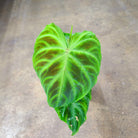
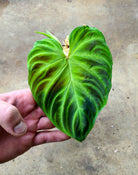
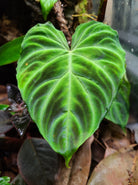
The foliage is among the most distinctive in the aroid world. Mature leaves are velvety and richly colored, often displaying deep emerald, olive, or dark green tones highlighted by bright lime-green to yellow venation. Under ideal conditions, the leaf surface develops an almost iridescent quality, giving the plant a depth and richness that photographs rarely capture. The undersides frequently exhibit reddish or bronze pigmentation, adding another layer of visual interest.
The species is equally famous for its petioles, which are densely covered in fine bristly hairs. This feature gives rise to the name verrucosum, meaning "warty" or "roughened." Combined with the velvet foliage, these textured petioles create a plant that appears almost prehistoric in character.
One of the most fascinating aspects of Philodendron verrucosum is how dramatically it changes when allowed to climb. Juvenile plants often produce relatively modest leaves, but once aerial roots establish onto cork bark, tree fern fiber, driftwood, or moss-covered surfaces, foliage size and complexity can increase substantially. In mature specimens, leaves may become several times larger than their juvenile counterparts, developing increasingly dramatic coloration and venation.
Humidity plays a major role in successful cultivation. Levels between 70–100% generally produce the healthiest growth, cleanest leaf emergence, and most vibrant foliage. While acclimated specimens can tolerate somewhat lower humidity, the species truly excels when atmospheric moisture remains consistently elevated.
Bright filtered light is ideal. In habitat, direct sunlight is largely blocked by rainforest canopy cover, and similar conditions typically produce the most attractive plants in cultivation. Too little light may reduce coloration and slow growth, while harsh direct exposure can damage the delicate velvet foliage.
The root system benefits from highly aerated growing media. Mixes containing orchid bark, tree fern fiber, coarse perlite, pumice, sphagnum moss, charcoal, and other chunky components allow roots to remain moist while receiving abundant oxygen. Dense, compacted substrates are generally poorly tolerated over the long term.
For vivarium keepers, Philodendron verrucosum is often used as a climbing focal specimen in larger tropical enclosures. It pairs exceptionally well with Marcgravia, mosses, miniature orchids, Peperomia, Begonias, and other cloud forest plants. The bold foliage provides a striking contrast to finer textures and contributes significantly to the layered rainforest aesthetic that many naturalistic enclosures aim to achieve.
Among velvet-leaf aroids, few species combine beauty, personality, and ecological authenticity as successfully as Philodendron verrucosum. Its spectacular foliage, cloud forest origins, and strong climbing behavior have made it one of the defining plants of modern tropical plant collecting and vivarium culture.