

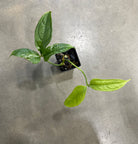
Anthurium croatii
Pickup available at 1420 Costner School Road - MUST SCHEDULE LOCAL PICKUP ORDERS - 6787991161
Usually ready in 2-4 days
Native to the humid tropical forests of Central and South America, particularly Panama, Ecuador and surrounding regions of northwestern South America, Anthurium croatii is a rare species within the Araceae family valued for its elongated foliage, climbing tendencies, and distinctly elegant rainforest growth habit. Named in honor of renowned aroid botanist Dr. Thomas Croat, this species remains relatively uncommon in cultivation but has steadily gained attention among collectors seeking more naturalistic epiphytic Anthuriums suited for high-humidity tropical environments.
Unlike the thick cordate velvet foliage associated with many popular collector Anthuriums, Anthurium croatii develops narrower elongated leaves with a graceful arching structure that gives the plant a highly refined jungle appearance. Mature foliage often develops subtle texture and prominent venation while maintaining a softer more streamlined silhouette than many terrestrial Anthurium species. This elegant growth habit makes it particularly attractive in vertically oriented displays and planted vivarium systems.
In habitat, Anthurium croatii commonly grows in warm humid rainforest conditions where it behaves as an epiphyte or hemi-epiphyte, attaching itself to trees and organic debris while receiving constant moisture, airflow, and filtered canopy light. These ecological preferences translate exceptionally well to mounted culture and tropical vivarium conditions where humidity remains elevated and roots can remain well aerated.
One of the strongest qualities of this species is its adaptability to vertical hardscape. It performs exceptionally well mounted to cork bark, tree fern panels, driftwood, moss poles, and vivarium backgrounds where aerial roots can naturally establish over time. In mature tropical setups, the plant gradually develops a layered epiphytic appearance that pairs beautifully with mosses, Marcgravia, miniature orchids, gesneriads, ferns, and other climbing tropical species.
Because of its epiphytic tendencies, substrate structure is critically important. Anthurium croatii prefers highly breathable mixes that remain moist while allowing substantial oxygen exchange around the roots. Orchid bark, coarse perlite, tree fern fiber, sphagnum moss, pumice, charcoal, coco husk, and other chunky tropical substrate components generally provide excellent long-term results. Dense compacted soils are poorly tolerated and can quickly lead to root decline.
Humidity between 70–100% is ideal, especially during active growth and acclimation. Elevated humidity encourages stronger aerial root development, cleaner leaf emergence, and healthier overall growth. At the same time, moderate airflow should always accompany these conditions to mimic the constantly moving air of rainforest environments and prevent stagnation around the foliage.
Bright filtered light produces the best growth and foliage quality. In lower lighting conditions the plant may become stretched and less vigorous, while harsh direct exposure can damage foliage, particularly in enclosed humid environments. Stable warmth combined with gentle filtered lighting generally produces the most attractive specimens.
Juvenile plants adapt especially well to tropical terrariums and larger vivarium systems where they can gradually establish onto vertical surfaces. As the species matures, it becomes increasingly impressive as a climbing rainforest accent plant capable of integrating naturally into moss-heavy tropical layouts.
For collectors interested in uncommon epiphytic Anthuriums with elegant foliage and strong vivarium potential, Anthurium croatii offers a highly naturalistic tropical aesthetic that rewards stable humid conditions with graceful long-term growth.