


Marcgravia rectiflora
Pickup available at 1420 Costner School Road - MUST SCHEDULE LOCAL PICKUP ORDERS - 6787991161
Usually ready in 2-4 days
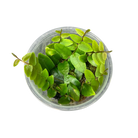
*Now a part of our MiniCup series (picture 2)*
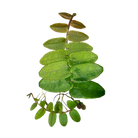
In nature, Marcgravia rectiflora spends much of its life climbing tree trunks and branches beneath dense forest canopies where humidity remains consistently high and sunlight is heavily filtered. Juvenile plants produce tightly overlapping leaves that press closely against their growing surface, creating the characteristic "shingling" effect that has made Marcgravia species so popular in naturalistic vivariums. As plants mature, foliage often becomes larger and growth accelerates, allowing the vine to gradually cover backgrounds, cork bark, tree fern panels, and driftwood with lush tropical greenery.
Among the various Marcgravia species in cultivation, M. rectiflora strikes an excellent balance between vigor and manageability. It grows steadily without being overwhelmingly aggressive, making it suitable for both small and medium-sized vivariums. Its relatively small leaves maintain scale exceptionally well in dart frog enclosures and help create the appearance of an established rainforest ecosystem without quickly dominating the enclosure.
One of the reasons this species performs so well in vivarium environments is its natural adaptation to epiphytic growth. Rather than requiring deep substrate, Marcgravia rectiflora readily attaches itself to vertical surfaces using adhesive roots that develop along the stem. Once established, the plant often requires very little intervention beyond occasional trimming and humidity maintenance. Given time, it can create stunning living walls and natural transitions between hardscape elements.
High humidity is one of the keys to success with this species. Conditions between 70–100% humidity typically produce the strongest attachment, healthiest foliage, and most attractive shingling growth. While the plant appreciates consistently moist conditions, it also benefits from gentle airflow that helps replicate the moving air found within tropical forests.
Bright filtered lighting produces the most compact growth and strongest coloration. Under excessively low light, internodes may elongate and shingling may become less dense. In contrast, strong indirect lighting often encourages tighter growth and improved attachment to surfaces.
Within vivariums, Marcgravia rectiflora is frequently used to soften backgrounds, cover cork bark panels, climb driftwood, and create natural pathways between epiphytic plantings. It pairs exceptionally well with miniature orchids, Peperomia species, Selaginella, mosses, ferns, and tropical gesneriads. The species is also a favorite among dart frog keepers because it provides visual cover, increases usable climbing surfaces, and contributes significantly to the overall rainforest aesthetic of an enclosure.
Although highly adaptable, the plant performs best when given a surface to climb rather than being allowed to trail indefinitely. Cork bark, tree fern fiber, hygrolon, and natural wood all make excellent mounting surfaces and often encourage the most attractive shingling growth.
For vivarium enthusiasts seeking one of the classic rainforest vines, Marcgravia rectiflora remains among the finest species available. Its combination of tropical beauty, manageable growth, strong climbing behavior, and long-term vivarium performance has made it a staple in naturalistic dart frog enclosures around the world.