


Begonia rajah
Pickup currently unavailable at 1420 Costner School Road - MUST SCHEDULE LOCAL PICKUP ORDERS - 6787991161
Native to Terengganu in Peninsular Malaysia, Southeast Asia, Begonia rajah is a remarkable terrestrial species in the Begoniaceae family and one of the classic jewel-like Begonias for humid terrarium and vivarium culture. Endemic to Peninsular Malaysia and naturally associated with wet tropical rainforest, this species combines compact growth with extraordinary bullate foliage, making it exceptionally well suited to close-up viewing in planted tropical enclosures.
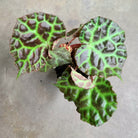
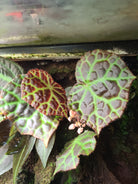
Few Begonias have foliage quite like B. rajah. The leaves develop a deeply puckered, almost reptilian surface, with raised areas and recessed veins producing a three-dimensional texture that becomes increasingly pronounced as the plant matures. Coloration can range through olive green, bronze, copper, chocolate, and reddish tones, typically contrasted by brighter green venation. Fresh growth can be especially colorful, adding warm red and copper shades before the leaves mature.
The species has an interesting history in cultivation. Begonia rajah was collected in Peninsular Malaysia in the late nineteenth century and formally described in 1894. Remarkably, it then went nearly a century without being documented again in the wild before being rediscovered in Terengganu in 1989. Plants persisted in botanical and private collections during that interval, making B. rajah an excellent example of how ex situ horticultural collections can preserve unusual tropical species.
Its growth habit is particularly useful for terrariums. Begonia rajah is a low-growing rhizomatous Begonia, gradually expanding laterally rather than producing a tall, cane-like structure. Established specimens generally remain relatively short while developing leaves that can approach several inches across. The result is a substantial-looking plant that still maintains excellent scale within medium and larger vivariums.
Although B. rajah appreciates consistently humid air, its root environment requires considerably more nuance. This is not a plant that should simply be kept soaking wet because it is a rainforest species. The rhizome and fine root system benefit from a loose, exceptionally well-drained substrate that provides moisture without remaining stagnant. Tree fern fiber, fine orchid bark, sphagnum, pumice or perlite, and other porous organic components can be combined to create the balance of moisture retention and aeration it prefers.
Allowing the upper substrate to breathe between waterings is generally preferable to maintaining permanent saturation. In a humid vivarium, atmospheric moisture greatly reduces how frequently the root zone needs to be soaked. This distinction—humid air but aerated roots—is particularly important with many specialized terrarium Begonias.
Bright filtered to moderate indirect light produces attractive compact growth and can enhance the warm coloration of developing foliage. Harsh direct light should be avoided. The deeply textured leaves are best appreciated beneath diffuse terrarium lighting, where the raised portions of the blade catch light differently from the recessed veins and emphasize the species' remarkable surface structure.
Warm tropical temperatures are appropriate, and elevated humidity is strongly beneficial. In enclosed vivariums, however, some air movement should still be maintained. Gentle circulation helps prevent moisture from sitting indefinitely on the bullate foliage while preserving the humid atmosphere the plant favors.
Mature plants may also produce attractive pink flowers with contrasting yellow centers. The blooms are not necessarily the primary reason to grow Begonia rajah, but their delicate appearance provides a beautiful contrast against the heavy, sculptural foliage when established specimens flower.
In the Vivarium
Begonia rajah is almost tailor-made for humid tropical terrariums and vivariums. Its slow-to-moderate, low-growing habit allows it to remain visually proportional far longer than many conventional Begonias, while its intricate foliage rewards the close viewing distances inherent to enclosed displays.
Use it as a foreground-to-midground specimen where the leaves remain visible rather than allowing vigorous vines or groundcovers to engulf it. Moss-covered cork bark, weathered wood, stone, leaf litter, and fine-textured tropical plants provide excellent visual companions. Leaving a little open space around the plant also improves airflow and allows its unusual leaf architecture to stand out.
Its documented geographic range makes Begonia rajah particularly valuable for Malaysian and Southeast Asian biotope-inspired vivariums. For FrogDaddy biotope organization, this species can confidently be associated with Malaysia, Peninsular Malaysia, Terengganu, Southeast Asia, and Asia.
For collectors seeking a Begonia that truly benefits from terrarium culture rather than merely tolerating it, Begonia rajah is an exceptional species. Its compact stature, extraordinary bullate foliage, fascinating cultivation history, and affinity for warm, humid environments have made it a classic among serious Begonia and vivarium enthusiasts.