

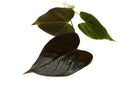
Anthurium chamberlanii
Pickup currently unavailable at 1420 Costner School Road - MUST SCHEDULE LOCAL PICKUP ORDERS - 6787991161
Native to the tropical rainforests of Central and South America, particularly regions of Panama and northwestern South America, Anthurium chamberlainii is a rare climbing member of the Araceae family prized for its elongated pendant foliage, strong epiphytic tendencies, and highly elegant rainforest appearance. Though less commonly encountered than many velvet-leaf Anthuriums, this species has become increasingly appreciated among collectors who favor more naturalistic jungle forms and true tropical growth habits.
Unlike the broad cordate foliage seen in many terrestrial Anthurium species, Anthurium chamberlainii develops narrow elongated leaves that arch and drape gracefully as the plant matures. The foliage possesses a refined tropical appearance that feels distinctly adapted for humid cloud forest and rainforest environments, where plants climb trees and suspend themselves among moss-covered branches and epiphytic vegetation.
In habitat, this species commonly grows as an epiphyte or hemi-epiphyte attached to tree trunks and organic debris in warm humid forests with constant airflow and frequent moisture. These environmental conditions make it particularly well suited for greenhouse cabinets, tropical vivariums, mounted culture, and high-humidity terrarium systems where roots can remain oxygenated while foliage experiences stable atmospheric moisture.
One of the most attractive aspects of Anthurium chamberlainii is its suitability for mounted and vertical growing applications. The plant adapts exceptionally well to cork bark, tree fern panels, driftwood, moss poles, and vivarium backgrounds where aerial roots can attach naturally over time. In mature tropical setups, it develops a distinctly wild epiphytic appearance that integrates beautifully among mosses, Marcgravia, orchids, ferns, and other climbing aroids.
As with many epiphytic Anthuriums, substrate structure is extremely important. Dense waterlogged media are poorly tolerated long term. Instead, the species performs best in highly breathable mixes containing orchid bark, tree fern fiber, coarse perlite, sphagnum moss, charcoal, coco husk, pumice, and other chunky tropical components that allow strong airflow around the root system.
Humidity between 70–100% produces the most vigorous growth and healthiest foliage, particularly during active climbing phases and new leaf emergence. Consistent humidity also encourages stronger aerial root production and more natural epiphytic behavior. Moderate airflow should always accompany elevated humidity to replicate the constantly moving air of rainforest environments.
Bright filtered lighting is ideal. In nature, the species typically grows beneath forest canopy cover where sunlight is diffused through surrounding vegetation. Excessively intense direct lighting can stress foliage, while overly dim conditions may reduce vigor and elongate internodes.
Juvenile plants adapt particularly well to larger vivarium systems and tropical terrariums where stable humidity and climbing surfaces are available. As the plant matures, it becomes increasingly impressive as a vertical accent species, especially when allowed to naturalize across cork bark or moss-covered hardscape.
For collectors interested in rarer epiphytic Anthuriums with strong tropical character and exceptional mounting potential, Anthurium chamberlainii offers a distinctly natural rainforest aesthetic that differs substantially from more commonly cultivated terrestrial velvet species.